
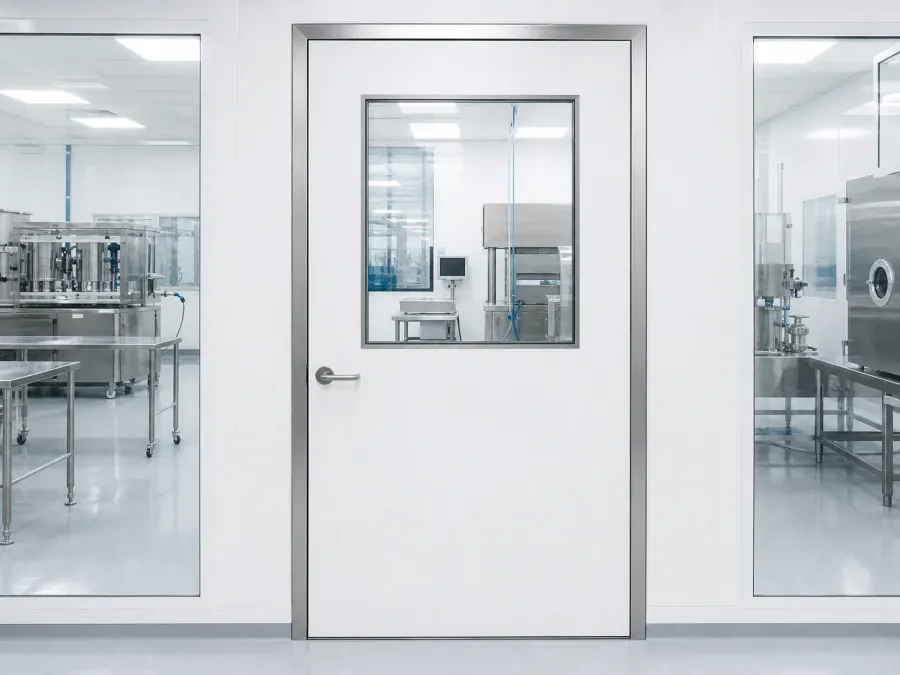
In controlled production areas, door selection affects the entire hygiene chain — from particle control to room pressure. We look at how GMP and ISO 14644 compliance shapes door design.
In pharmaceutical manufacturing, biotechnology and sterile production areas, cleanroom doors are not just a passage point — they are a critical component that preserves the integrity of the controlled environment. A door's tightness, surface structure and automation behavior directly affect particle load and room pressure.
ISO 14644 classifies cleanrooms by particle concentration. The air movement a door creates while opening and closing can, with poor design, degrade the performance of a higher-class room. This is why an airtight, gasketed structure, smooth and easy-to-clean surfaces, and a design suitable for positive/negative pressure environments come to the fore.
GMP (Good Manufacturing Practice) in turn requires materials and details that reduce the risk of microbial growth and simplify cleaning. Antibacterial surface options, seamless transitions and joint-minimizing construction meet this expectation.
Cleandoor cleanroom doors are engineered to meet project compliance requirements with PP honeycomb, aluminium honeycomb and compact laminate panel options, stainless steel or electrostatic powder-coated frame alternatives, and manual/automatic/hermetic operation options.